
The American Dream has always been anchored in a home—a place of stability, security, and a foundation upon which to build a life. For generations, this dream was a tangible goal. Today, for an ever-growing segment of the population, it feels more like a mirage. The United States is in the midst of a profound housing affordability crisis, and understanding the supply crisis—this dual-headed dragon of soaring housing costs and a crippling lack of inventory—is essential to fixing it. At TerraNova Alliance, our mission is to directly address this challenge through sustainable housing development, creating safe, stable communities while generating strong returns for our investment partners.
To solve this fundamental need for safety and stability, we must first confront the scale of the problem. According to a 2021 report from the National Association of Realtors, the United States faces a housing shortage of over 5.5 million units. This deficit is driven by restrictive zoning laws that prioritize single-family homes, skyrocketing construction costs for materials like lumber and steel, and a growing scarcity of available land near major job centers.
Attainable vs. Affordable: A Crucial Distinction
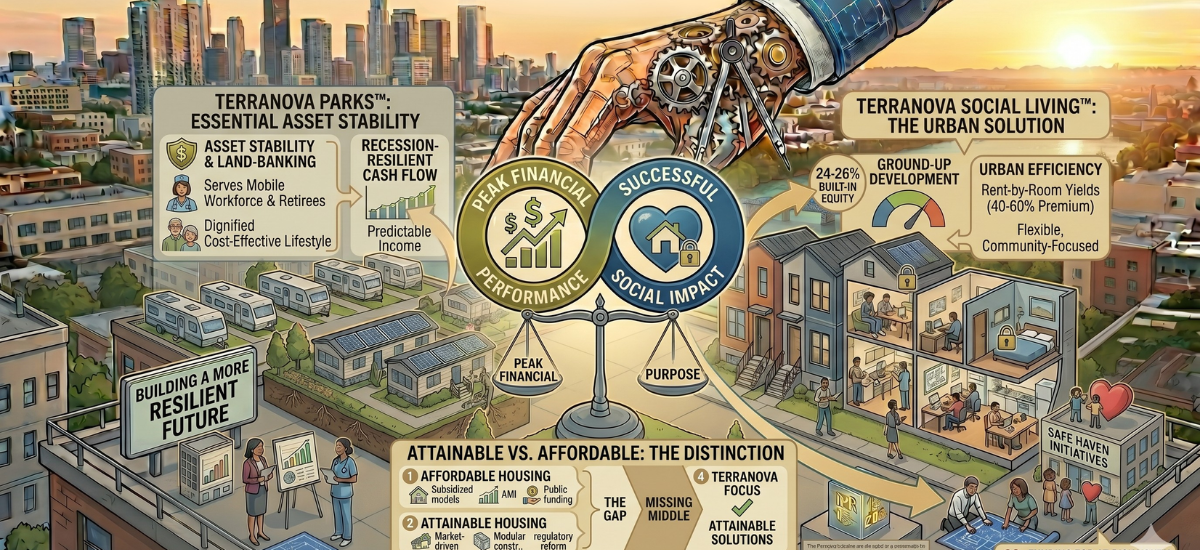
While often used interchangeably, the distinction between “affordable” and “attainable” housing is vital for creating market-based solutions. Affordable Housing is primarily a policy-driven concept tied to Area Median Income (AMI), often requiring government subsidies or tax credits to bridge the gap for the most vulnerable populations. While critical, it frequently carries a stigma and faces significant developmental opposition.
In contrast, Attainable Housing is market-rate housing accessible to the working-class and middle-income population—essential workers like teachers, nurses, and first responders. It is achieved through private sector innovation, such as modular or prefabricated construction, and regulatory reforms that allow for increased density. For TerraNova Alliance, focusing on attainability allows us to bring scalable, market-driven solutions to the supply shortage without relying on perpetual public funding.
TerraNova Parks™: Stability in Essential Assets
One of our primary vehicles for addressing this crisis is TerraNova Parks™. This branch focuses on RV parks, mobile home communities, and campgrounds as a foundation for long-term, unsubsidized affordable housing. These communities are not merely transient vacation spots; they serve the mobile workforce, retirees, and young families who have been priced out of traditional markets.
The investment thesis for TerraNova Parks™ is grounded in asset stability and land-banking. We transform underutilized land into durable, predictable cash-flow vehicles. These assets are considered recession-resilient because they offer a dignified, cost-effective lifestyle during economic downturns. Our model targets properties in high-growth corridors where demand structurally outpaces supply.
TerraNova Social Living™: The Urban Solution
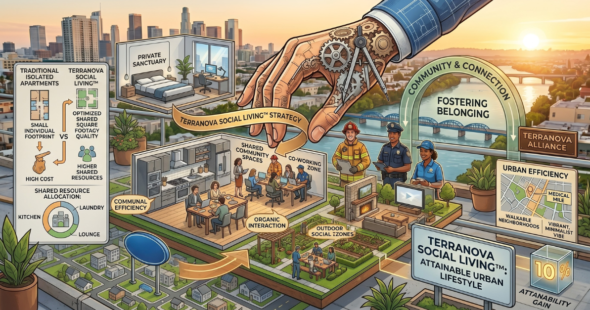
Our second branch, TerraNova Social Living™, utilizes a ground-up development strategy focused on urban co-living. We build high-density, shared-resource housing—such as 12-bed/12-bath duplexes—designed for the modern workforce, including students and traveling medical professionals.
The financial model for Social Living is built on urban efficiency. By maximizing rent-by-room yields, this model offers a 40–60% premium compared to traditional apartments. Furthermore, projects like Burress Heights in Houston demonstrate the ability to create significant value, with approximately 24-26% built-in equity from day one. This approach allows us to capitalize on the critical shortage of flexible, community-focused housing in high-growth urban areas.
Profit with Purpose
At the heart of the TerraNova Alliance is a two-fold mission: Profit and Purpose. We believe every dollar deployed should measure peak financial performance alongside successful social impact. Our vision is to establish a national network of safe, sustainable, and empowering communities, specifically leveraging profits to fund specialized care and security for at-risk youth and survivors of human trafficking.
By deploying private capital into these innovative and overlooked asset classes, we are not just building real estate; we are building a more resilient and hopeful future for the people who keep our nation running.