In the world of private real estate syndication, the “deal”—the physical asset, the location, and the renovation plan—often takes center stage. However, for sophisticated investors, the legal and financial architecture behind the deal is just as critical. At TerraNova Alliance, we recognize the importance of fund structure as the bedrock of trust between a sponsor and their partners. Understanding how fees and returns are structured isn’t just about accounting; it’s about understanding incentives. When a fund is structured correctly, the sponsor only wins when the investors win.
The Anatomy of Alignment: Our 50/50 Model
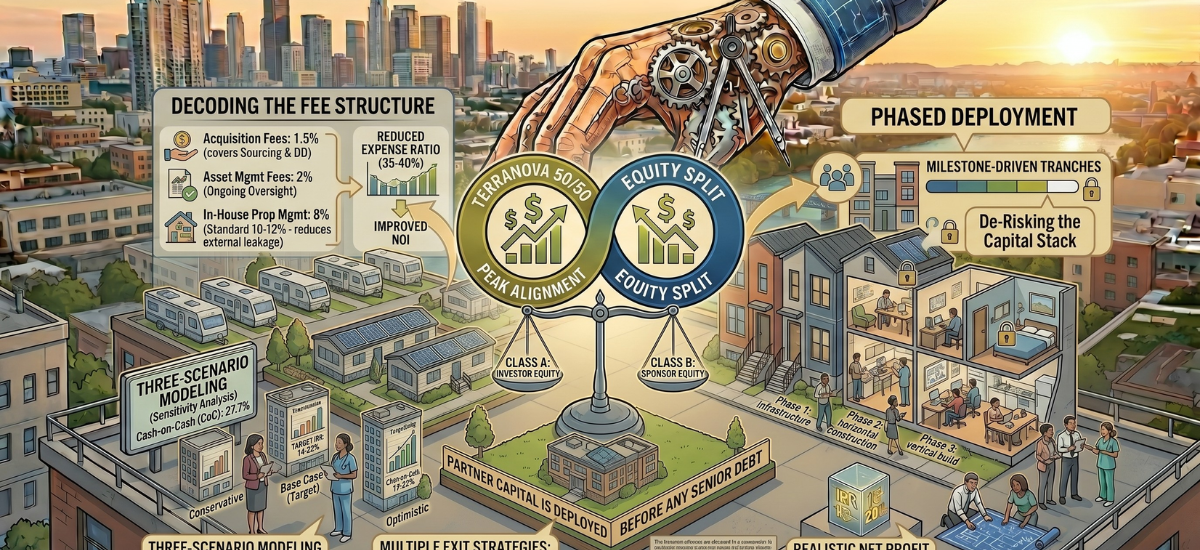
One of the most common questions we receive from family offices and individual equity partners is how we align our interests with theirs. At TerraNova, we typically utilize a clean 50/50 equity split between the Partners (Class A) and the Sponsor (Class B).
This aligned equity split means that as the Managing Member, TerraNova Alliance remains fully incentivized to drive operational excellence. We don’t just manage the assets; we often self-manage them through our in-house teams. This allows us to keep management fees lower than third-party providers—typically around 8% compared to the industry standard of 10-12%—and ensures that brand standards and resident experiences are maintained without leakage to external vendors.
Decoding the Fee Structure
Transparency in fees is non-negotiable. While every deal varies slightly, the standard components of our fund structures include:
- Acquisition Fees: Typically around 1.5%, covering the heavy lifting of sourcing, off-market negotiations, and initial due diligence.
- Asset Management Fees: A standard 2% fee that ensures the ongoing oversight of the project, from financial reporting to executing the value-add strategy.
- Property Management: By keeping this in-house, we reduce the expense ratio (often targeted at 35-40%) which directly improves the Net Operating Income (NOI).
By clearly defining these costs upfront, we eliminate “fee creep” and ensure that the projected Internal Rate of Return (IRR) is a realistic reflection of the net profit potential.
Phased Deployment: De-Risking the Capital Stack
Beyond fees, the timing of capital deployment is a vital part of fund structure. TerraNova Alliance utilizes a phased capital deployment strategy. Instead of taking a lump sum and letting it sit idle, we release funds in milestone-driven tranches—Phase 1 for infrastructure, Phase 2 for horizontal construction, and so on.
This milestone-based approach protects investor capital at every phase. Our equity-first model ensures that partner capital is deployed before any senior bank debt is drawn, significantly reducing foreclosure risk and ensuring that the project is built on a foundation of solid equity.
Returns in Context: Scenarios and Realities
Investors should always look at returns through the lens of sensitivity analysis. We provide three-scenario modeling—Conservative, Base Case, and Optimistic—to show how the deal performs under various market conditions.
For hypothetical urban infill or workforce housing developments, we target an IRR in the 14-22% range with Cash-on-Cash (CoC) returns around 27.7%. These aren’t just numbers; they are supported by conservative underwriting that assumes higher-than-market vacancy (up to 30%) and modest rent growth.
Conclusion: The TerraNova Advantage
At the end of the day, a fund structure should be a tool for protection. Multiple exit strategies—from portfolio sales to cash-out refinances—ensure that we aren’t locked into a single path if market conditions shift.
By combining mission-driven community development with institutional-quality financial structures, we provide our partners with a unique opportunity: to solve the affordable housing crisis while generating exceptional, risk-adjusted returns.
Legal Disclaimer
This article is for informational and educational purposes only and does not constitute an offer to sell or a solicitation of an offer to buy any securities. TerraNova Alliance is a private real estate investment and development firm, not a registered investment advisor or broker-dealer. All investment opportunities are intended for accredited investors only under Rule 506(c) of Regulation D. Real estate investments involve a high degree of risk, and past performance is not indicative of future results. All projections and targeted returns (like those discussed in this article) are forward-looking statements for illustrative purposes only. Consult your own legal and financial professional before making any investment decision.
Interested in learning more about our current opportunities? Complete our partner form for us to reach out.