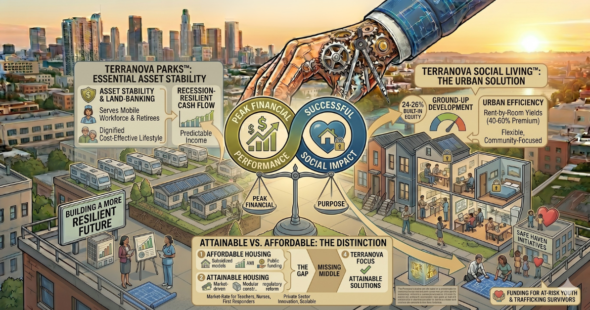


In communities across the country, a quiet crisis is unfolding. It affects the people who form the backbone of our daily lives: the teachers who educate our children, the nurses who care for our families, and the first responders who keep our neighborhoods safe. They have steady jobs and stable incomes, yet they are increasingly priced out of the very communities they serve.
This is the challenge of the “missing middle,” and the solution is workforce housing.
As a firm dedicated to financing, building, and preserving quality housing, we at TerraNova Alliance believe it’s crucial to have a clear conversation about what workforce housing is and, just as importantly, what it is not. This isn’t just a real estate category; it’s a vital asset class that ensures the health and stability of our communities.
What is Workforce Housing?
At its core, workforce housing is housing that is affordable for households earning between 60% and 120% of the Area Median Income (AMI).
These are not low-income households; they are the “missing middle.” They earn too much to qualify for traditional subsidized housing programs but not enough to afford the escalating costs of market-rate or luxury apartments in their area.
Think of:
- Police officers and firefighters
- Teachers and school administrators
- Nurses and medical technicians
- Retail managers and skilled tradespeople
When these essential professionals are forced into long commutes or rent-burdened situations, the entire community feels the strain. Workforce housing provides a stable, high-quality, and dignified solution, allowing them to live and thrive where they work.
Debunking 3 Common Myths About Workforce Housing
Misconceptions about housing often create barriers to building these necessary communities. Let’s clear the air on three of the most common myths.
Myth 1: “Workforce housing is just another name for subsidized ‘low-income’ housing.”
Fact: This is the most significant misconception. While both are crucial, they serve different populations.
- Subsidized Housing (like Section 8 or public housing) is typically reserved for very low-income households, often at 30% to 50% of the AMI.
- Workforce Housing serves a moderate-income bracket (60% to 120% AMI).
These residents are gainfully employed and pay rent, often without direct government subsidies. The “affordability” in workforce housing is often achieved through innovative financing, public-private partnerships, or zoning incentives that reduce development costs—not through direct rental vouchers.
Myth 2: “Developing workforce housing will lower my property values.”
Fact: This fear is unfounded. Dozens of studies from across the nation have consistently shown that well-designed, professionally managed workforce and affordable housing developments have no negative impact on surrounding property values.
In many cases, these developments can even increase property values by replacing underutilized or blighted properties with new, high-quality construction. By providing stable housing for a reliable workforce, these properties contribute to the economic health and desirability of the entire neighborhood.
Myth 3: “These properties are low-quality, poorly managed, and look ‘cheap’.”
Fact: This is demonstrably false. “Affordable” does not mean “cheap.” Workforce housing must adhere to the exact same building codes, design standards, and material quality requirements as any market-rate luxury apartment.
The savings are found in the financing structure, not by cutting corners on construction.
At TerraNova Alliance, we see these properties as long-term investments in a community. Like any high-performing real estate asset, they are professionally managed and meticulously maintained to preserve their value and, most importantly, to provide a quality home for their residents. These developments are indistinguishable from their market-rate counterparts, featuring modern amenities, quality finishes, and strong community engagement.
Why Workforce Housing is a Smart, Stable Asset Class
Beyond its profound social impact, workforce housing is one of the most resilient and stable asset classes in real estate.
Unlike the luxury market, which can be volatile and subject to a “concessions race,” the demand for workforce housing is constant and overwhelming. There is a structural undersupply of housing for the “missing middle,” which translates to:
- High Occupancy: These properties consistently maintain high and stable occupancy rates.
- Low Turnover: Residents are often rooted in the community, leading to lower turnover and more stable cash flow.
- Recession Resilience: During economic downturns, demand for more affordable housing options actually increases, making workforce housing a reliable and counter-cyclical investment.
Our Commitment
At TerraNova Alliance, we are committed to providing capital and expertise for the entire spectrum of housing needs—from preserving critical affordable housing to financing new developments for our nation’s workforce. We believe that a community’s greatest asset is its people. By investing in stable, high-quality housing, we are ensuring that our teachers, nurses, and first responders can remain a vibrant part of the communities they serve.