

For the modern investor, the conversation has fundamentally changed. It’s no longer just about financial returns; it’s about returns and responsibility. This shift has propelled Environmental, Social, and Governance (ESG) criteria from a niche interest to a core component of portfolio strategy.
While the “E” (Environmental) is often clearly understood through green buildings and carbon reduction, and the “G” (Governance) is defined by corporate ethics, the “S” (Social) has remained a more abstract concept. How does an investor tangibly measure social impact? How can capital be deployed to directly and positively affect people’s lives?
For those seeking a clear, measurable, and profound social impact, there is no better example than workforce housing.
The “S” Isn’t Vague—It’s a Home
At its core, the “Social” pillar of ESG is about a company’s relationship with its stakeholders—employees, suppliers, and, most importantly, the communities in which it operates. It’s about fostering inclusive and equitable environments, enhancing well-being, and providing access to opportunity.
This is precisely where workforce housing makes its mark.
The “missing middle”—our teachers, nurses, first responders, and skilled service workers—are the lifeblood of our communities. Yet, in market after market, they are priced out, facing the crushing burden of housing instability. This instability isn’t just a line item on a budget; it has cascading negative effects on:
- Health: Financial stress and long commutes are detrimental to physical and mental well-being.
- Education: Children of families who are forced to move frequently are more likely to fall behind in school.
- Economic Mobility: When over half of a paycheck goes to rent, there is nothing left for savings, investment, or upward mobility.
Investing in workforce housing is a direct intervention. It’s not an abstract pledge or a corporate donation. It is the creation and preservation of a physical asset—a safe, high-quality, and stable home—that provides the foundation for a family to thrive.
A Tangible Social Good That Strengthens Communities
Unlike other “S” initiatives that can be difficult to quantify, the impact of workforce housing is immediate, visible, and deeply rooted in the community.
1. It Provides Foundational Stability: A stable home is the platform upon which all other successes are built. For the resident, it means security. It means children can stay in the same school district. It means being able to save for the future instead of worrying about the next rent hike. For an investor, this “stickiness” translates into lower turnover and more predictable, stable returns—a perfect alignment of social and financial goals.
2. It Builds Equitable and Resilient Cities: A community cannot function if the people who serve it cannot afford to live there. When teachers, healthcare workers, and firefighters are forced into “super-commutes,” it strains public services, weakens the local economy, and erodes the very fabric of the community. By financing housing for these essential workers, investors are directly ensuring the long-term health, safety, and resilience of the entire city.
3. It Offers a Measurable, Reportable Impact: For the ESG-conscious investor, impact must be reportable. Workforce housing delivers. The “S” can be measured in:
- The number of individuals and families served.
- The affordability is preserved (e.g., rents kept at a stable percentage of the Area Median Income).
- The resident demographic (e.g., the percentage of essential workers housed).
- The high resident retention rates, which are a clear indicator of a stable, successful community.
Aligning Your Capital with Your Values
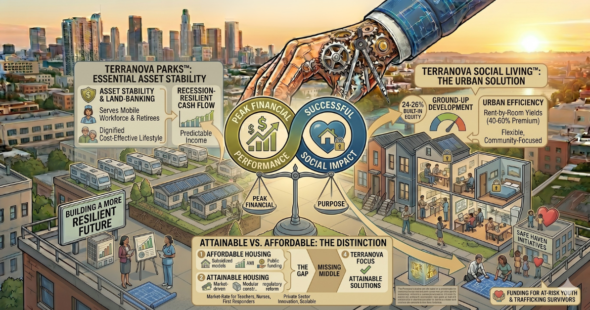
As a firm, TerraNova Alliance has long recognized that financial performance and positive social outcomes are not mutually exclusive. In fact, in workforce housing, they are intrinsically linked.
The same factors that make it a powerful social investment—the overwhelming and non-discretionary demand, the low vacancy, and the resident stability—are the very factors that make it a resilient and defensive financial investment.
You are investing in an asset class with a structural, long-term supply/demand imbalance. You are meeting a fundamental human need. And in doing so, you are participating in a dual-return strategy where your capital is both preserved and purposeful.
Investing in workforce housing is the “S” in ESG made tangible. It is the decision to finance not just buildings, but communities. It’s an investment in the teacher who educates our children and the nurse who cares for our families. It is, quite simply, one of the most direct and powerful ways to align your financial goals with a measurable social good.
Partner with TerraNova Alliance to Make an Impact
At TerraNova Alliance, we provide the capital and expertise necessary to create and preserve these critical community assets. We are actively seeking to partner with investors, developers, and community leaders who share our commitment to this dual-return strategy.
If you are an investor looking to deploy capital that achieves stable, risk-adjusted returns while delivering a tangible social impact, let’s talk.
If you are a developer seeking a reliable and experienced capital partner to bring a workforce housing project to life, we have the solutions. Contact TerraNova Alliance today to learn more about our investment opportunities and financing solutions in the workforce housing sector.