In the world of multifamily investment, two areas get all the attention: gleaming, new-construction Class A towers and deeply subsidized affordable housing (like the LIHTC properties we are deeply committed to).
But in between lies the “missing middle”—workforce housing.
These properties are the bedrock of our communities, housing teachers, nurses, first responders, and skilled service workers. They are also, from an investment standpoint, one of the most compelling and overlooked opportunities in real estate.
These are not trophy assets. They are often 20-40 years old, lack modern amenities, and suffer from “tired” management. And that is exactly why we like them.
At TerraNova Alliance, we don’t buy and hold, hoping for market appreciation. We buy and execute, forcing appreciation through a disciplined, three-part playbook. This is how we identify, underwrite, and reposition these critical assets to deliver value for our investors and our residents.
Part 1: The “Where” and “What” – Our Acquisition Criteria
You can’t have a great business plan for a bad asset. Our “secret sauce” starts with an exceptionally disciplined sourcing and identification process. We look for a very specific set of characteristics.
- “B” Locations with “A” Drivers: We target properties in submarkets with long-term, non-cyclical employment anchors. We want to be near hospitals, universities, logistics hubs, and stable government centers. The property itself might be a “C+” asset, but it must be in a “B” location that provides a durable tenant base.
- The “Good Bones” Vintage: We love properties built between the 1980s and early 2000s. These buildings typically have solid construction, but their interiors, amenities, and operating systems are dated. They are ripe for a modern refresh without requiring a full, gut-level rehabilitation.
- The “Management Gap”: Our ideal target is an underperforming asset with a clear “management gap.” This is often a property owned by an original builder or a mom-and-pop operator who hasn’t invested in new technology, professional marketing, or proactive expense management. We see that gap as a pure value-add opportunity.
Part 2: The “Why” – Underwriting a Business Plan, Not Just a Property
Once we identify a target, our underwriting process begins. For us, underwriting is not a passive spreadsheet exercise; it’s the creation of a detailed, asset-level business plan.
Many investors project generic 3% rent increases and 2% expense inflation. We go deeper.
Our model is built line-by-line. We identify exactly where the operational and financial “leaks” are. Is the property paying for unbilled utilities? Is unit turnover taking 30 days when it should take 10? Are they leaving $50 per unit on the table by not offering an upgraded finish package?
We underwrite to a provable future, not a hypothetical one. Our pro-forma is based on the specific, granular value-add initiatives we plan to execute, allowing us to stress-test our returns against rising interest rates or a softening in the market. If the deal still works, we move forward.
Part 3: The “How” – Our 3-Pronged Value-Add Strategy
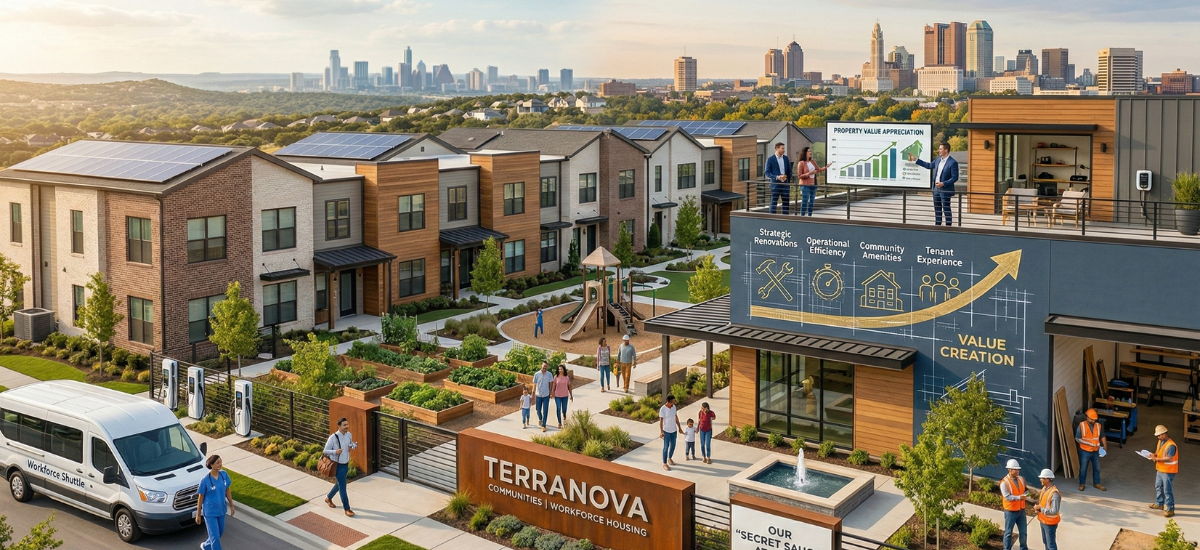
This is where we force appreciation. Our business plan activates on Day 1 and focuses on three core areas simultaneously.
1. Driving Operational Efficiencies
This is the lowest-cost, highest-impact way to add value. We professionalize management and attack the expense side of the ledger.
- Expense Control: We audit all service contracts, from landscaping to trash, to ensure we’re not overpaying.
- Utility Recapture: We often implement Ratio Utility Billing Systems (RUBS) to ensure residents are accountable for their consumption, a move that dramatically cuts utility costs and promotes conservation.
- Reducing Turnover: By improving the resident experience and maintenance response times, we reduce costly vacancy and turnover—a direct boost to the bottom line.
2. Executing Strategic Cap-Ex
This isn’t about luxury; it’s about livability and durability. Our capital expenditure (Cap-Ex) plan is designed for maximum ROI, focusing on items that tenants will pay a premium for and that lower future maintenance costs.
- Interiors: We replace dated carpet with durable luxury vinyl plank (LVP) flooring. We upgrade light fixtures, hardware, and plumbing fixtures, and resurface (or replace) countertops for a clean, modern feel.
- Exteriors & Amenities: First impressions are everything. A new coat of paint, modern signage, improved landscaping, and a refreshed pool or fitness area create “curb appeal” that justifies higher rents and makes residents proud to live there.
3. Implementing Smart Tech
Technology is no longer an amenity; it’s an expectation. It also happens to be a powerful tool for reducing operating costs.
- Resident Portals: We implement systems for online rent payments and digital maintenance requests. This streamlines collections, reduces administrative burden, and improves the resident experience.
- Smart-Home Features: In-unit tech like smart thermostats and smart locks provides convenience for residents while giving management better control over utility costs in vacant units and simplifying turnover.
The Result: A “Win-Win”
This playbook—Identify, Underwrite, Execute—is how we systematically transform “tired” properties into thriving, profitable communities.
We are not passive investors. We are active operators who create value through discipline and hard work. By forcing appreciation, we deliver superior, risk-adjusted returns for our partners. And, just as importantly, we preserve and improve a critical supply of housing, offering a higher quality of life for the workforce that powers our economy.