
Analyzing the Demand Curve
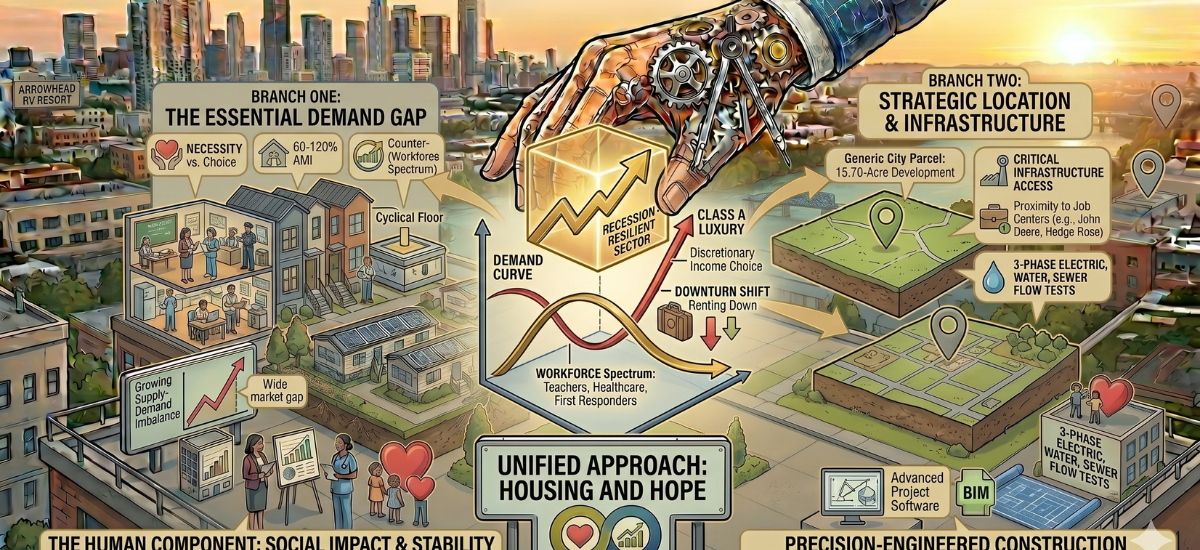
In an era of economic volatility, real estate investors are increasingly looking beyond traditional asset classes to find stability and long-term growth. While luxury developments and office spaces often feel the brunt of market corrections, workforce housing has consistently proven to be a recession resilient sector in the industry. At TerraNova Alliance, we specialize in high-density communities purpose-built for the full workforce spectrum, operating under a unified approach to housing and hope.
But what exactly makes workforce housing so durable? The answer lies in a fundamental analysis of the demand curve and the essential nature of the “missing middle.”
The Essential Demand for the Missing Middle
Workforce housing typically targets individuals and families earning between 60% and 120% of the Area Median Income (AMI). These are our teachers, healthcare workers, police officers, and service industry professionals—the backbone of any local economy. Unlike luxury housing, which is often a choice driven by discretionary income, workforce housing is a necessity.
During an economic downturn, the demand curve for housing undergoes a significant shift, highlighting why these properties are so recession resilient. As household budgets tighten, many residents in Class A luxury apartments “rent down” into more affordable Class B and C workforce housing. This creates a unique counter-cyclical effect where vacancy rates in workforce housing often remain low or even decrease while other sectors struggle. This “floor” in demand provides a level of protection against the rental income volatility that plagues higher-end assets.
A Growing Supply-Demand Imbalance
One of the strongest indicators that an asset class will remain recession resilient is the widening gap between the supply of affordable units and the growing demand. For years, development has skewed heavily toward luxury products where margins are perceived to be higher. This has left a massive market gap that TerraNova Alliance is actively filling.
Because the barriers to entry for new construction—such as rising material costs and complex zoning—often restrict new supply, existing workforce housing assets become increasingly valuable. Our team at TerraNova Alliance, led by CEO Ramse Rogers and COO Mitch Hardington, leverages decades of combined experience to navigate these complexities and build a highly recession resilient portfolio.
The Human Component: Impact and Stability
At TerraNova Alliance, we believe that sustainable workforce housing is about more than just buildings; it is about social impact initiatives. Our mission is to deliver precision-engineered construction solutions through transparent partnerships. When residents have safe, high-quality, and affordable places to live, they are more likely to stay, leading to lower turnover costs and more stable cash flows for investors.
We utilize advanced project management software and BIM (Building Information Modeling) to keep our developments on track, ensuring we deliver communities that stand the test of time. Whether it is transforming RV resorts into luxury-hookup communities or developing high-density residential units, our focus remains on providing precision and quality.
Conclusion: The Path Forward
The demand for workforce housing is not a trend; it is a permanent fixture of the real estate landscape. By analyzing the demand curve, it becomes clear that investing in a recession resilient asset class like the “missing middle” offers a rare combination of lower risk and steady returns. As we continue to expand our pipeline—from RV Resorts to new multi-family projects—TerraNova Alliance remains committed to creating a legacy of resilient communities.
Investing in workforce housing is more than a smart financial move; it is an investment in the stability and hope of the modern workforce.